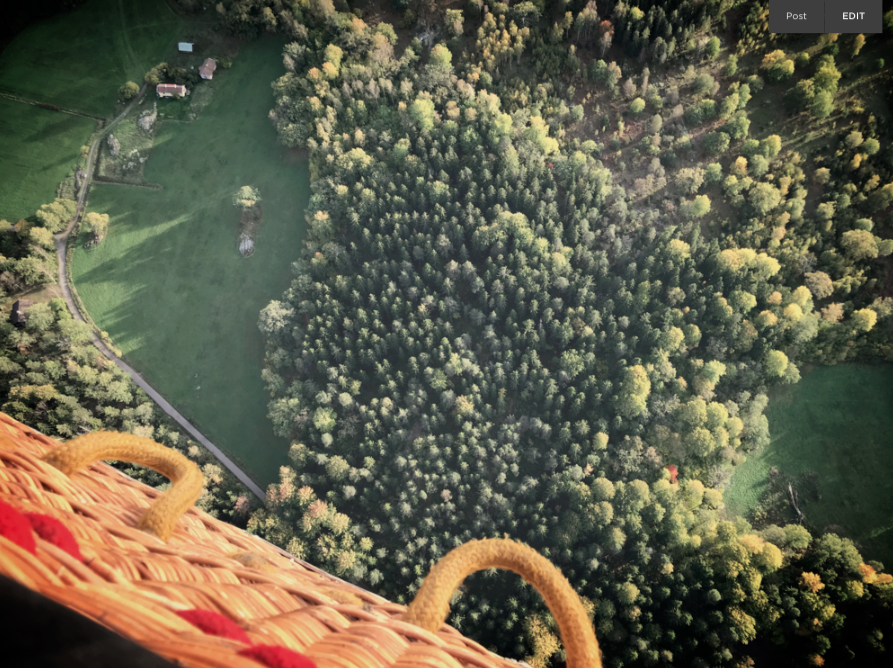
It was a bit surreal flying in a big red and white air balloon over the forests just north of Stockholm. In the first moments of flight we were so close to the pines, birches, alders, and maples, below that we brushed their tops. Then the quiet buoyancy was interrupted when the balloons engine fire roared, and an elk sprang out from the underbrush. A good start.
I thought I would be scared, but I wasn’t. I was hanging like a basket of fruit 400 meters up in the air, and it felt so natural, and that was the strangest part.
Floating slowly along I began to look for patterns on the landscape below. Our Force Majeure group had been thinking a lot about the weaving of farming and forest, inspired by Farmer Gotsch a man in Brazil who “behaves like a giraffe”. We had been deeply inspired by his syntropic (opposite of entropic) farming which took the form of rich diverse food forests. His yields are often as much or more then those of industrial agriculture and fair much better during times of drought, while simultaneously building healthy soils, generating water and weather, yielding more nutrient dense food, and asking for no outside chemical inputs. One unique aspect of syntropic farming that really stood out for me was the way Gotsch himself spoke about his work, and the metaphors he chose to use, all of which showed me he was an artist with a loving and hands-on connection to living systems. This quote particularly resonated with everyone in our Force Majeure group:
“We are not the smart ones, we are part of a intelligent system. I am not the owner, nor the boss or manager. I am an endobiont of the macro-organism” - Ernst Gotsch
As I floated above the landscape of Sweden I saw endless the little pockets of farming surrounded by expansive forest. The trees were sometimes farmed and clear-cut, but in a less heavy handed way then other places I have observed in the northwest United States. There was some diversity in tree species, as noted by slight variation in color and movement, more yellow here, more black-green there. This was heartening to see. I could also tell the soil below was thin and rocky in places, since every now and again some granite would peek out, with vegetation growing out from all the crevices. I reminded myself to try and see into the landscape below, not just passively watch it pass.
It was almost as if the land below was asking to be rewoven where a forest becomes a farm, and a farm becomes a forest, the boundaries fluid and intertwined. This kind of seeing and thinking could generate a new kinds of landscapes the world over with less boundaries and more resilience in the face of rapid temperature rise and extremes in precipitation. Over the next phase of work we will be looking into seeing and then designing such a vision for the country of Sweden, a country that has the potential to become a great food and foraging forest, woven into the landscape for the benefit of the whole.