During my work at the Center for the Force Majeure, a question has come up over and over about the role that the arts and culture can play in influencing planning and policy. Inherently the Force Majeure Centers work touches on both these topics, by repeatably calling for vast changes in the way we see and interact with living systems. I believe that the artist has the potential to see the world as plastic, a great canvas of creativity, and therefore are tuned to the types of spontaneous ideas that are coded out of traditional planning processes. Think of the possibilities.
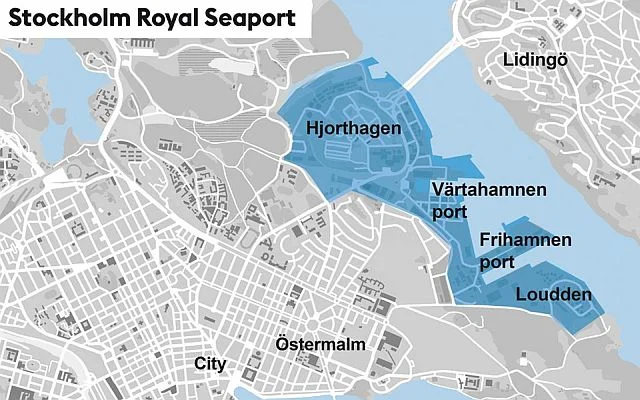
Our center had been invited to Stockholm by an art group called Mossutstallningar (Moss in english) for a art exhibit called Artistic Undressing’s, which was conceived of as an artist led generative critique of the development in the Stockholm Royal Seaport. This development had been advertised as the ultimate “sustainable development”, one that the rest of Sweden and the world could learn from. The reality however, as is often the case, was very different.
The first dysfunctional symptom was the lived story of Stella the director of Mossutstallningar and her art group. They have been pushed out of the harbor area because they raised her rent by just a cool 600%. Looking closely at this development scheme one quickly finds many dysfunctional guiding metaphors, loosely referencing ideas of a utopic “New Urbanism”. Put very simply, new urbanism advocates for tightly packed mixed-use housing, that is walkable and less resource intensive. It is a nice thought in principle, but in practice something else begins to appear. Thousands of small square apartments, a few random restaurants, lots of beige and grey, and hyper-curated patches of grass surrounded by concrete.
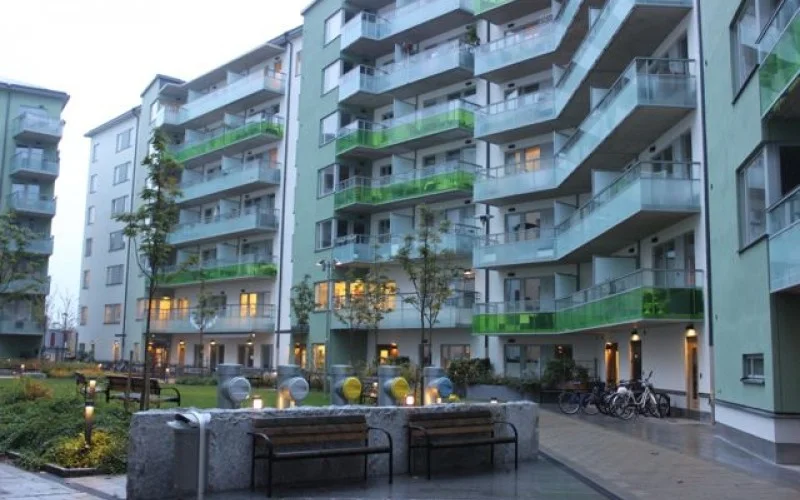
Our “sustainable” accommodations in the Royal Seaport development.
Stella had booked an apartment for us to stay in one of these sustainable developments of the Royal Harbor so we experienced this phenomena first hand. Everything felt very controlled, made of straight lines, shiny glass, with very little life, few inviting places to gather, let alone verdant growing walls, roofs or creative and colorful playgrounds for the kids to play in. We often reflected on sterile tone of it all during our time there.
It is in this context that we had a meeting with Stockholm city planners in a nondescript brick building with fluorescent lights. Two women and one man, all seemed surprisingly perky. I thought maybe we had a chance co-create? I could see in their eyes that we “artists” were perceived of as an oddity, a refreshing break from endless paperwork and standardization.
To begin Newton presented his past works of art that made a tangible impact on planning: Baltimore Promenade, Knowle West, The Greenheart of Holland. As he spoke I watched them become more and more intrigued, not sure what to make of this eccentric artist who clearly had worked in their territories before, even successfully, but had also clearly come from another world.
Then we turned to them and asked: What is the worse piece of planning in your city? and alternatively, what is the best planning in your city? We got a rather generic but telling answer: The worst planning is done when the developers tell the city planners what they want to do, the best planning is when city planners think ahead and make a plan for the developers. This is when they brought out the big guns… enter “The Green Index”. They then began speaking about the new developments being planned according to this numerically based “green index”. A rating system that makes developers meet some minimum standards in order to build in an area. Lastly they added, it was helpful but that developers are experiencing a “learning curve”. We all found this idea absurd… on a learning curve while developing a city that will last for hundreds of years and impact millions of lives?
This is when it started to get interesting as we now could see the deep limitations in thinking that were at play. We mentioned that developers will only do the absolute minimum to meet the requirements of the “green index”, and have very little financial incentive for inspired creativity. We asked if they had thought through this limitation, possibly designing creatively themselves to envision greater possibilities? They looked at us blankly, then started to get defensive. They said that the green index was in fact very new and innovative, and besides that, developers don’t like to be told what to do. (My question: Do inspiring ideas have to become mandates? maybe, and maybe not.)
We then talked about vertical orchards, community foraging gardens, promenades, while they looked at us with annoyed amusement. So one of them said, “ok that is all great, but what would you do on the north side of a building wall that gets very little sun?”. We all were shocked at the how basic of a problem this was, the response: work with botanists to make a design with shade tolerant species, a solution so simple it’s almost painful. However her question was telling, it showed a deep disconnect between the city planning process and understanding the basics of the living, breathing world.
We all left stunned. Newton and Ruby threw out working with Stockholm city planners at all. I decided to do a piece entitled “False Comfort and Stockholm’s Green Index”. I also spoke with Stella about making a visual workbook of “creative possibilities” to offer developers, hoping to spark whatever amount of visionary spirit they may have that sees beyond a “green index”.